A couple of suggestions for applying the [[nodiscard]] attribute in C++ code.
In the previous blog post, I shared some thoughts on [[nodiscard]]. As I wrote there, it would be better to have a good default of always assuming [[nodiscard]], and opt out from that good default only in some specific cases. But, unfortunately, the current state of the C++ language standard is different, and actually the opposite of the above.
So, where would I strongly recommend to apply [[nodiscard]]?
The Case of Bad Confusing Naming Choices
A common case that comes to my mind is the example of std::vector::empty. I have always found that vector’s method name confusing. I mean: Is “empty” a method to empty the vector, that is to remove its content? No. std::vector::empty is a bool-returning method to check if the vector has no element.
So, in this case, applying [[nodiscard]] to the vector::empty method will make the C++ compiler generate a warning when you write this kind of C++ code:
// myVector is a std::vector

// Empty the vector content [NOTE: Wrong code]
myVector.empty();
As can be read from the comment above, the intention of the programmer was to empty the vector. But the vector::empty method simply returned a bool to check if the vector had no elements. And, in the above case, that returned value was discarded.
So, the use of the [[nodiscard]] attribute with the vector::empty method will generate a warning in the above bogus case. It’s like the C++ compiler telling the programmer: “Hey, programmer! You discarded the return value of vector::empty!” So the programmer thinks: “Hey, what return value? Wait a minute… I just wanted to empty the vector! Ahhh…Ok. I got it: This vector::empty method returns a bool and is used to check if the vector is empty. So, the method I should call is another one!” And then, after some search, the vector::clear method is invoked and the above code fixed.
// Correct code to empty the vector:
myVector.clear();
Note: The so maltreated MFC, with its CArray class, did choose a much better naming for its “empty” method, calling it IsEmpty. With such a good name, you won’t certainly make the mistake of invoking IsEmpty when you actually meant to make the vector empty. The designers of the STL made a confusing choice for the vector::empty method: calling it is_empty would have been much better and clear.
So, this is actually a case in which [[nodiscard]] comes to the rescue for a bad confusing choice for naming methods.
The Case of Returning Raw Owning Resource Handles
Another important case where I strongly suggest to apply the [[nodiscard]] attribute is when you return to the caller some rawowning handle or pointer (which you can think of as an “handle” to memory resources).
For example, in my WinReg C++ library, I wrap a raw Windows Registry HKEY handle in the safe boundaries of the RegKey C++ class.
However, for flexibility of design, I chose to have a RegKey::Detach method that transfers the ownership of that HKEY raw handle to the caller:
// Transfer ownership of current HKEY to the caller.
// Note that the caller is responsible for closing the key handle!
[[nodiscard]] HKEY Detach() noexcept;
After invoking that method, the caller becomes the new owner of the returned HKEY. As such, the caller will be responsible for properly tracking and releasing the raw handle when not needed anymore.
In such cases, discarding (by mistake) the returned value of the RegKey::Detach method would cause a resource leak. So, having the C++ compiler speak up in such cases would definitely help in preventing such leaks. So, if you have to be selective of where you apply the [[nodiscard]] attribute, this is certainly a great place for it!
Some reflections on the use (or abuse?) of the [[nodiscard]] attribute introduced in C++17.
An interesting addition made in C++17 has been the [[nodiscard]] attribute. The basic idea is to apply it such that the C++ compiler will emit a warning when the return values of functions or methods are discarded.
Someone said that, even in previous versions of the C++ standard, if your C++ compiler didn’t emit a warning when you discard the return value of functions or methods, you should discard that C++ compiler.
Really?
Well, consider this simple piece of C++ code:
int GetSomething()
{
    return 10;
}

int main()
{
    GetSomething();
}
I tried compiling that code with VS 2019 at warning level 4 (which is a good warning level for VC++), and the code compiles successfully, with no warnings emitted by the VC++ compiler.
Of course, I won’t discard VC++, as I consider it the best C++ compiler for Windows (and Visual Studio is my favorite IDE for Windows).
On the other hand, if I add the [[nodiscard]] attribute to the GetSomething function:
[[nodiscard]] int GetSomething()
{
    ...
then the VC++ compiler does emit a warning message:
warning C4834: discarding return value of function with ‘nodiscard’ attribute
So, should C++ compilers emit warnings on discarded return values by default?
Well, if you think about it, printf returns an int, which I think a lot of programmers discard 🙂
So, if C++ compilers would emit such warnings by default, compiling lots of code that uses printf to print some text to the standard output would result in very noisy compilations.
Well, you may argue that printf comes from C. But I could reply that it’s used a lot in C++ (at least until the recent std::print and related formatting functions added in C++20/23).
Moreover, even focusing on more C++-specific features, even something like operator= overloads return a reference that is many times discarded:
So, assuming a default [[nodiscard]] policy, that would indeed generate lots of noisy compilation sessions!
On the other hand, adding [[nodiscard]] to many functions and methods can result in very noisy and kind of cluttered code, too.
So, we need to find a balance here.
A good alternative could be adding [[nodiscard]] to structs or classes or enumerations that represent an error information or something that shouldn’t be discarded, so the C++ compiler will automatically apply the [[nodiscard]] behavior to functions and methods that return those [[nodiscard]] classes or enumerations. Note that this behavior is already implemented in C++17, and available in C++ compilers like Visual C++ 2019.
Another option I was thinking about is this: Assume [[nodiscard]] behavior as the default, and opt out using another attribute, like [[maybe_discarded]], in cases like the operator= overloads, in which discarding the returned value or reference is perfectly sensible. This would adhere to the philosophy of good defaults. In other words, if you don’t specify anything, you’ll get [[nodiscard]] behavior by default, and warning messages. And in those specific cases when discarding the returned value can make sense, only there you specify an explicit attribute like [[maybe_discarded]].
A few small extra steps at the beginning, that will save you lots of time and headaches during C++ project development!
One of the very first things I do after creating a new C++ project in Visual Studio is setting the Visual C++ compiler warning level 4. I consider this a best practice when writing C++ code compiled with the Microsoft Visual C++ compiler. In fact, I prefer having the VC++ compiler speak out more frequently, as it helps finding bugs (and fixing them) earlier in the development cycle.
To do so, in the Solution Explorer view in Visual Studio, right click on your C++ project name, and select Properties from the menu.
Right-click on the project name in Solution Explorer in Visual Studio……then select the project Properties menu item.
The dialog box showing the project’s properties will appear.
In Configuration Properties on the left, select C/C++. Then change the Warning Level property from the default Level3 (/W3) to Level4 (/w4). Confirm clicking the OK button.
Setting the Warning Level property to Level4 (/W4).
Enjoy your C++ project development!
I wish the warning level 4 was the default setting in Visual Studio for C++ projects! For me, this would adhere to the philosophy of having good defaults.
Pay attention to the target of the address-of (&) operator!
Suppose that you have some data stored in a std::vector, and you need to pass it to a function that takes a pointer to the beginning of the data, and in addition the data size or element count.
Something like this:
// Input data to process
std::vector<int> myData = { 11, 22, 33 };

//
// Do some processing on the above data
//
DoSomething(
    ??? ,         // beginning of data
    myData.size() // element count
);
You may think of using the address-of operator (&) to get a pointer to the beginning of the data, like this:
But the above code is wrong. In fact, if you use the address-of operator (&) with a std::vector instance, you get the address of the “control block” of std::vector, that is the block that contains the three pointers first, last, end, according to the model discussed in a previous blog post:
Taking the address of a std::vector (&v) points to its control block
Luckily, if you try the above code, it will fail to compile, with a compiler error message like this one produced by the Visual C++ compiler in VS 2019:
Error C2664: 'void DoSomething(const int *,size_t)':
cannot convert argument 1
from 'std::vector<int,std::allocator<int>> *' to 'const int *'
Types pointed to are unrelated; conversion requires reinterpret_cast, C-style cast or function-style cast
What you really want here is the address of the vector’s elements stored in contiguous memory locations, and pointed to by the vector’s control block.
To get that address, you can invoke the address-of operator on the first element of the vector (which is the element at index 0): &v[0].
// This code works
DoSomething(&myData[0], myData.size());
As an alternative, you can invoke the std::vector::data method:
DoSomething(myData.data(), myData.size());
Now, there’s a note I’d like to point out for the case of empty vectors:
If size() is 0, data() may or may not return a null pointer.
CppReference.com
I would have preferred a well-defined behavior such that, when size is 0 (i.e. the vector is empty), data() must return a null pointer (nullptr). This is the good behavior that is implemented in the C++ Standard Library that comes with VS 2019. I believe the C++ Standard should be fixed to adhere to this intelligent behavior.
An example of writing clear code with good intention, but getting an unexpected C++ compiler error.
Someone asked me for help with their C++ code. The code was something like this:
std::wstring something;
std::optional<bool> result = something.empty() ?
        ReadBoolValueFromRegistry() : {};
The programmer who wrote this code wanted to check whether the ‘something’ string was empty, and if it was, a boolean value had to be read from the Windows registry, and then stored into the std::optionalresult variable.
On the other hand, if the ‘something’ string was not empty, the std::optional result should be default-initialized to an empty optional (i.e. an optional that doesn’t contain any value).
That was the programmer’s intention. Unfortunately, their code failed to compile with Visual Studio 2019 (C++17 mode was enabled).
The offending C++ code with squiggles under the {
There were squiggles under the opening brace {, and the Visual C++ compiler emitted the following error messages:
Error Code
Description
C2059
syntax error: ‘{‘
C2143
syntax error: missing ‘;’ before ‘{‘
I was asked: “What’s the problem here? Are there limitations of using the {} syntax to specify nothing?”
This is a good question. So, clearly, the C++ compiler didn’t interpret the {} syntax as a way to default-initialize the std::optional in case the string was not empty (i.e. the second “branch” in the conditional ternary operator).
A first step to help the C++ compiler figuring out the programmer’s intention could be to be more explicit. So, instead of using {}, you can try and use the std::nullopt constant, which represents an optional that doesn’t store any value.
// Attempt to fix the code: replace {} with std::nullopt
std::optional<bool> result = something.empty() ?
        ReadBoolValueFromRegistry() : std::nullopt;
Unfortunately, this code doesn’t compile either.
Why is that?
Well, to figure that out, let’s take a look at the C++ conditional operator (?:). Consider the conditional operator in its generic form:
// C++ conditional operator ?:
exp1 ? exp2 : exp3
In the above code snippet, “exp2” is represented by the ReadBoolValueFromRegistry call. This function returns a bool. So, in this case the return type of the conditional operator is bool.
// Attempt to fix the code: replace {} with std::nullopt
std::optional<bool> result = something.empty() ?
        ReadBoolValueFromRegistry() : std::nullopt;
//             ^^^--- exp2             ^^^--- exp3
//             Type: bool
On the other hand, if you look at “exp3”, you see std::nullopt, which is a constant of type std::nullopt_t, not a simple bool value!
So, you have this kind of type mismatch, and the C++ compiler complains. This time, the error message is:
Error C2446 ‘:’: no conversion from ‘const std::nullopt_t’ to ‘bool’
So, to fix that code, I suggested to “massage” it a little bit, like this:
// Rewrite the following code:
//
// std::optional<bool> result = something.empty() ?
//        ReadBoolValueFromRegistry() : {};
//
// in a slightly different manner, like this:
//
std::optional<bool> result{};
if (something.empty()) {
    result = ReadBoolValueFromRegistry();
}
Basically, you start with a default-initialized std::optional, which doesn’t contain any value. And then you assign the bool value read from the registry only if the particular condition is met.
The above C++ code compiles successfully, and does what was initially in the mind of the programmer.
P.S. I’m not a C++ “language lawyer”, but it would be great if the C++ language could be extended to allow the original simple code to just work:
std::optional<bool> result = something.empty() ?
        ReadBoolValueFromRegistry() : {};
First, let’s reveal the mystery of the “fixed 24-byte sizeof”; then, let’s see how to properly get the total size, in bytes, of all the elements stored in a std::vector.
Someone was modernizing some legacy C++ code. They had an array defined like this:
int v[100];
and they needed the size, in bytes, of that array, to pass that value to some function. They used sizeof(v) to get the previous array size.
When modernizing their code, they chose to use std::vector instead of the above raw C-style array. And they still used sizeof(v) to retrieve the size of the vector. For example:
The output they got when building their code in release mode with Visual Studio 2019 was 24. They also noted that they always got the same 24 output, independently from the number of elements in the std::vector!
This is clearly a bug. Let’s try to shed some light on it and show the proper way of getting the size of the total number of elements stored in a std::vector.
First, to understand this bug, you need to know how a std::vector is implemented. Basically, at least in Microsoft STL implementation (in release builds, and when using the default allocator1), a std::vector is made by three pointers, kind of like this:
Typical implementation of std::vector with three pointers: first, last, end
first: points to the beginning of the contiguous memory block that stores the vector’s elements
last: points one past the last valid element stored in the vector
end: points one past the end of the allocated memory for the vector’s elements
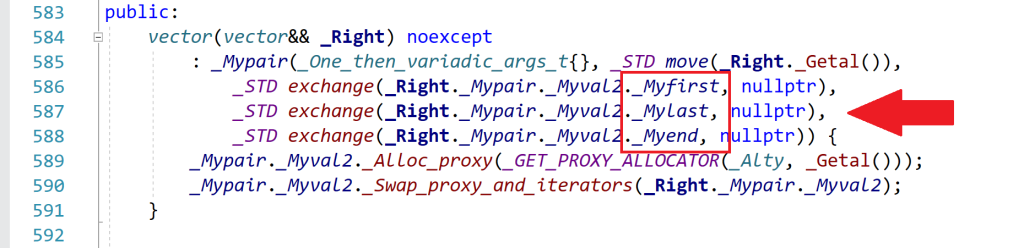
Spelunking inside the Microsoft STL implementation, you’ll see that the “real” names for these pointers are _Myfirst, _Mylast, _Myend, as shown for example in this part of the <vector> header:
An excerpt of the <vector> header that comes with Microsoft Visual Studio 2019
So, when you use sizeof with a std::vector instance, you are actually getting the size of the internal representation of the vector. In this case, you have three pointers. In 64-bit builds, each pointer occupies 8 bytes, so you have a total of 3*8 = 24 bytes, which is the number that sizeof returned in the above example.
As you can see, this number is independent from the actual number of elements stored in the vector. Whether the vector has one, three, ten or 10,000 elements, the size of the vector’s internal representation made by those three pointers is always fixed and given by the above number (at least in the Microsoft’s STL implementation that comes with Visual Studio2).
Now that the bug has been analyzed and the mystery explained, let’s see how to fix it.
Well, to get the “size of a vector”, considered as the number of bytes occupied by the elements stored in the vector, you can get the number of elements stored in the vector (returned by the vector::size method), and multiply that by the (fixed) size of each element, e.g.:
//
// v is a std::vector<int>
//
// v.size()    : number of elements in the vector
// sizeof(int) : size, in bytes, of each element
//
size_t sizeOfAllVectorElementsInBytes = v.size() * sizeof(int);
To write more generic code, assuming the vector is not empty, you can replace sizeof(int) with sizeof(v[0]), which is the sizeof the first element stored in the vector. (If the vector is empty, there is no valid element stored in it, so the index zero in v[0] is out of bounds, and the above code won’t work; it will probably trigger an assertion failure in debug builds.)
In addition, you could use the vector::value_type type name member to get the size of a single element (which would work also in the case of empty vectors). For example:
using IntVector = std::vector<int>;

IntVector v(100);

// Print the number of bytes occupied
// by the (valid) elements stored in the vector:
cout << v.size() * sizeof(IntVector::value_type);
To be even more generic, a helper template function like this could be used:
//
// Return the size, in bytes, of all the valid elements
// stored in the input vector
//
template <typename T, typename Alloc>
inline size_t SizeOfVector(const std::vector<T, Alloc> & v)
{
    return v.size() * sizeof(std::vector<T, Alloc>::value_type);
}


//
// Sample usage:
//
std::vector<int> v(100);
std::cout << SizeOfVector(v) << '\n';
// Prints 400, i.e. 100 * sizeof(int)
Bonus Reading
If you want to learn more about the internal implementation of std::vector (including how they represent the default allocator with an “empty class” using the compressed pair trick), you can read these two interesting blog posts on The Old New Thing blog:
Very easy! It’s just a matter of invoking a constructor with a type cast.
Last time we saw how to load a string resource into a wstring. As already explained, ATL/MFC’s CString does offer very convenient methods for Win32 C++ programming. So, how can you load a string resource into a CString instance?
Well, it’s very simple! Just pass the string ID to a CString constructor overload with a proper type cast:
// Load string with ID IDS_MY_STRING from resources
// into a CString instance
CString myString( (PCTSTR) IDS_MY_STRING );
You can even #define a simple preprocessor macro that takes the string resource ID and and creates a CString object storing the string resource:
When you need to pass a (localized) string loaded from resources to a Win32 API or ATL/MFC class member function that expects a string pointer (typically in the form of LPCTSTR/PCTSTR, i.e. const TCHAR*), then you can simply use the convenient macro defined above:
// Show a message-box to the user,
// displaying strings loaded from resources
MessageBox(nullptr,
           _S(IDS_SOME_MESSAGE_FOR_THE_USER),
           _S(IDS_SOME_TITLE),
           MB_OK);
How does that work?
Well, first the _S macro defined above creates a (temporary) CString object and loads the string resource into it. Then, the implicit LPCTSTR conversion operator provided by CString is invoked by the C++ compiler, so the (read-only) string pointer is passed to the proper parameter of the MessageBox API.
See how simple is that compared to using std::wstring, where we needed to create an ad hoc non-trivial function to load wstring from resources!
CString easily allows loading strings from resources “out of the box”. Let’s try to implement this feature for std::wstring.
As discussed in the previous blog post, CString offers convenient methods for Windows C++ programming, including those to load strings from resources.
What Is a String Resource and Why Should You Care?
Basically, in a Windows Win32 C++ application you can store your strings (like messages for the user) as resources, and then reference them in your C++ code via their IDs. If you want to localize your application for a different language, a translator can take the string resources and translate them into the destination language. The C++ source code remains the same, as it references strings not by their language-specific literal form (e.g. “Cannot access the Registry key XYZ”), but using language-neutral resource IDs (e.g. IDS_CANNOT_ACCESS_REGISTRY_KEY_XYZ).
Accessing String Resources via the LoadString(W) API
To access a Unicode (UTF-16) string resource, you can use the LoadStringW Win32 API.
Loads a string resource from the executable file associated with a specified module and either copies the string into a buffer with a terminating null character or returns a read-only pointer to the string resource itself.
From that paragraph, we get that there are two different behaviors available for this API:
Copy the string resource into a user-provided buffer.
Return a read-only pointer to the string resource itself.
Behavior #1: Copying the String Resource into a User-provided Buffer
The first behavior is shown several times in Microsoft documentation. For example, the doc page about LoadStringW refers to the following sample code:
Example code for LoadString referenced by the official Microsoft documentation
Basically, the idea here is to create a TCHAR buffer, and invoke LoadString to load the string resource into that buffer:
In Unicode builds, TCHAR becomes WCHAR (i.e. wchar_t), and LoadString becomes LoadStringW.
One of the problem of this kind of code is that the buffer is pre-allocated with a given fixed size. Then, what happens if the string read from resources is larger than the pre-allocated buffer? The string is silently truncated, as per the official MS documentation about the cchBufferMax parameter:
The string is truncated and null-terminated if it is longer than the number of characters specified.
This could make the UI ugly if it is just a user message string that gets truncated; or it can become a much more serious bug if the truncated string is something like the format specifier for some printf-like function.
Moreover, in that code there is no check on the return value of LoadString. So, if the function fails, the buffer could contain garbage, and that could cause other bugs. (Although, I understand that often MS documentation doesn’t include error checking; but it’s important to point that out, as often people copy-paste code from MS doc samples, and silent bugs are introduced in their own code.)
In addition, it’s important to remember to properly scale the “sizeof” the destination buffer, dividing it by sizeof(TCHAR), which is sizeof(WCHAR) == 2 (bytes) in Unicode builds. Failing to do so would cause additional buffer overflow problems.
You can use a std::wstring of proper size, and pass a pointer to the internal string characters instead of using a raw wchar_t array, but the aforementioned problems still remain.
Behavior #2: Getting a Read-only Pointer to the String Resource
To me the behavior #2 (which is: get a read-only pointer to the string resource itself) is what leads to better and easier code (despite some type cast). However, it’s not very clear from the current MS documentation how to operate the LoadStringW API in this “behavior #2” mode.
So, let’s explain that here. Let’s start with the function declaration:
int LoadStringW(
  [in, optional] HINSTANCE hInstance,
  [in]           UINT      uID,
  [out]          LPWSTR    lpBuffer,
  [in]           int       cchBufferMax
);
To enable behavior #2 (i.e. return a read-only pointer to the string resource itself), you need to pass 0 (zero) for the last parameter cchBufferMax.
If you pass zero for cchBufferMax, the LoadStringW API says: “Hey, the caller wants me to just return a read-only pointer to the string resource itself, with no deep-copies in a user-provided buffer. Ok, let’s do that!”
Where does the API get the information about the destination string pointer? In other words: Where can the LoadStringW API write the string resource’s address? Well, it uses the third parameter for that: lpBuffer.
However, there’s a gotcha here (that I think is not well documented in the official MS web page). Basically, you need to create a const wchar_t pointer that will store the address of the resource string (which is read-only, hence the const):
// Pointer to the start of the string resource
const wchar_t* pchStringBegin = nullptr;
Then you need to pass the address of this pointer as the lpBuffer parameter to LoadStringW: &pchStringBegin. Note that, in this way, you are using a double-indirection, i.e. a pointer-to-a-pointer. Since the lpBuffer parameter is declared as LPWSTR (i.e. wchar_t*), you have a type mismatch for this parameter. In fact, LoadStringW expects a simple wchar_t* pointer; but you are passing a pointer-to-a-wchar_t-pointer (double indirection). However, this type mismatch is needed and expected by the behavior #2, so in this case you can safely use reinterpret_cast to make the C++ compiler happy about that type mismatch.
So, the LoadStringW call can look like this:
// Invoke LoadStringW, requesting a pointer
// to the beginning of the string resource
int cchStringLength = ::LoadStringW(
        hInstance,
        resourceId,
        reinterpret_cast<PWSTR>(&pchStringBegin),
        0);
Note that the string resource is not necessarily NUL-terminated! But, thankfully, on success, the LoadStringW API returns the number of characters (as count of wchar_ts) in the string resource.
So, you can use these two pieces of information to build a std::wstring instance to safely store the string resource:
The pointer to the start of the string resource
The number of wchar_ts in the string resource
In code, this becomes:
if (cchStringLength > 0) // LoadStringW succeeded
{
    // Create a std::wstring storing the string loaded from resources
    return std::wstring(pchStringBegin, cchStringLength);
}
On failure, LoadStringW returns zero. Then you can choose if you want to throw an exception, log an error message, return an empty string to the user, return a std::optional<std::wstring>, or whatever.
Wrapping Up: An Easy-to-Use and Hard-to-Misuse Helper Function for Loading String Resources into std::wstring
To wrap up this blog post, this is a nice LoadStringFromResources reusable C++ function that you can invoke to load string resources into std::wstring:
//
// Load a string resource into a std::wstring
//
[[nodiscard]] std::wstring LoadStringFromResources(
    _In_opt_ HINSTANCE hInstance,
    _In_     UINT resourceId
)
{
	// Pointer to the first character of the string.
	// NOTE: *Not* necessarily null-terminated!!
	const wchar_t* pchStringBegin = nullptr;

	// Invoke LoadStringW, requesting a pointer
    // to the beginning of the string resource itself
	const int cchStringLength = ::LoadStringW(
            hInstance,
            resourceId,
            reinterpret_cast<PWSTR>(&pchStringBegin),
            0);

	ATLASSERT(cchStringLength >= 0);
	if (cchStringLength > 0)
	{
        // Success
		return std::wstring(pchStringBegin, cchStringLength);
	}
	else
	{
        // Failure: Throw an exception
		// const DWORD error = ::GetLastError();
		AtlThrowLastWin32();
	}
}
Revisiting one of my first blog posts from 2010. Should you pick CString or std::string? Based on what context (ATL, MFC, cross-platform code)? And why?
It’s interesting to revisit that post today toward the end of 2023, more than 10 years later.
So, should we use CString or std::string class to store and manage strings in our C++ code?
Well, if there is a need of writing portable C++ code, the choice should be std::string, which is part of the C++ standard library.
(Me, on January 4th, 2010)
Still true today. Let’s also add that we can use std::string with Unicode UTF-8-encoded text to represent international text.
But, in the context of C++ Win32 programming (using ATL or MFC), I find CString class much more convenient than std::string.
These are some reasons:
Again, I think that is still true today. Now let’s see the reasons why:
1) CString allows loading strings from resources, which is good also for internationalization.
Still valid today. (You have to write additional code to do that with STL strings.)
2) CString offers a convenient FormatMessage method (which is good for internationalization, too; see for example the interesting problem of “Yoda speak” […])
Again, still true today. Although in C++20 (20+ years later than MFC!1) they added std::format. There’s also something from Boost (the Boost.Format library).
3) CString integrates well with Windows APIs (the implicit LPCTSTR operator comes in handy when passing instances of CString to Windows APIs, like e.g. SetWindowText).
Still valid today.
4) CString is reference counted, so moving instances of CString around is cheap.
Well, as discussed in a previous blog post, the Microsoft Visual C++ compiler and C++ Standard Library implementation have been improved a lot since VS 2008, and now the performance of STL’s strings is better than CString, at least for adding many strings to a vector and sorting the string vector.
5) CString offers convenient methods to e.g. tokenize strings, to trim them, etc.
This is still a valid reason today. 20+ years later, with C++20 they finally added some convenient methods to std::string, like starts_with and ends_with, but this is very little and honestly very late (but, yes, better late than ever).
So, CString is still a great string option for Windows C++ code that uses ATL and/or MFC. It’s also worth noting that you can still use CString at the ATL/MFC/Win32 boundary, and then convert to std::wstring or std::string for some more complex data structures (for example, something that would benefit from move semantics), or for better integration with STL algorithms or Boost libraries, or for cross-platform portions of C++ code.
I used and loved Visual C++ 6 (which was released in 1998), and its MFC implementation already offered a great CString class with many convenient methods including those discussed here. So, the time difference between that and C++20 is more than 20 years! ↩︎
Let’s see how STL strings, ATL CString and strings coming from a custom pool allocator perform in a couple of interesting contexts (string vector creation and sorting).
Basically, the pool allocator maintains a singly-linked list of chunks, and string memory is carved from each chunk just increasing a string pointer. When there isn’t enough memory available in the current chunk to serve the requested allocation, a new chunk is allocated. The new chunk is safely linked to the previous chunk list maintained by the allocator object, and the memory for the requested string is carved from this new chunk. At destruction time, the linked list of chunks is traversed to properly release all the allocated memory blocks.
I measured the execution times to create and fill string vectors, and the execution times to sort the same vectors.
TL;DR: The STL string performance is great! However, you can improve creation times with a custom pool allocator.
The execution times are measured for vectors storing each kind of strings: STL’s wstring, ATL’s CString (i.e. CStringW in Unicode builds), and the strings created using the custom string pool allocator.
This is a sample run (executed on a Windows 10 64-bit Intel i7 PC, with code compiled with Visual Studio 2019 in 64-bit release build):
String benchmark: STL vs. ATL’s CString vs. custom string pool allocator
As you can note, the best creation times are obtained with the custom string pool allocator (see the POL1, POL2 and POL3 times in the “Creation” section).
For example:
String type
Run time (ms)
ATL CStringW
954
STL std::wstring
866
Pool-allocated strings
506
Sample execution times for creating and filling string vectors
In the above sample run, the pool-allocated strings are about 47% faster than ATL’s CString, and about 42% faster than STL’s wstring.
This was expected, as the allocation strategy of carving string memory from pre-allocated blocks is very efficient.
Regarding the sorting times, STL and the custom pool strings perform very similarly.
On the other hand, ATL’s CString shows the worst execution times for both creation and sorting. Probably this is caused by CString implementation lacking optimizations like move semantics, and using _InterlockedIncrement/_InterlockedDecrement to atomically update the reference count used in their CoW (Copy on Write) implementation. Moreover, managing the shared control block for CString instances could cause an additional overhead, too.
Historical Note: I recall that I performed a similar benchmark some years ago with Visual Studio 2008, and in that case the performance of ATL’s CString was much better than std::wstring. I think move semantics introduced with C++11 and initially implemented in VS2010 and then refined in the following versions of the C++ compiler, and more “programming love” given to the MSVC’s STL implementation, have shown their results here in the much improved STL string performance.
Benchmark Variation: Tiny Strings (and SSO)
It’s also possible to run the benchmark with short strings, triggering the SSO (to enable this, compile the benchmark code #define’ing TEST_TINY_STRINGS).
Here’s a sample run:
String benchmark with tiny strings: STL vs. ATL vs. custom string pool allocator
As you can see in this case, thanks to the SSO, STL strings win by an important margin in both creation and sorting times.








 Giovanni Dicanio's Blog