…Because (in the given context) that would be wrong 🙂
This “suggestion” comes up with some frequency…
The context is this: I have some Win32 C++ code that takes input string parameters as const std::wstring&, and someone suggests me to substitute those wstring const reference parameters with string views like std::wstring_view. This is usually because they have learned from someone in some course/video course/YouTube video/whatever that in “modern” C++ code you should use string views instead of passing string objects via const&. [Sarcastic mode on]Are you passing a string via const&? Your code is not modern C++! You are such an ignorant C++98 old-style C++ programmer![Sarcastic mode off] 😉
(There are also other “gurus” who say that in modern C++ you should always use exceptions to communicate error conditions. Yeah… Well, that’s a story for another time…)
So, Thank you for the suggestion, but using std::wstring_view instead of const std::wstring& in that context would introduce nasty bugs in my C++ code (and in other people’s code that relies on my own code)! So, I won’t do that!
In fact, my C++ code in question (like WinReg) talks to some Win32 C-style APIs. These expect PCWSTR as input parameters representing Unicode UTF-16 strings. A PCWSTR is basically a typedef for a _Null_terminated_ const wchar_t*. The key here is the null termination part.
If you have:
// Input string passed via const&.
//
// Someone suggests me to replace 'const wstring &'
// with wstring_view:
//
//     void DoSomething(std::wstring_view s, ...)
//
void DoSomething(const std::wstring& s, ...)
{
    // This API expects input string as PCWSTR,
    // i.e. _null-terminated_ const wchar_t*.
    SomeWin32Api(s.data(), ...); // <-- See the P.S. later
}
std::wstring guarantees that the pointer returned by the wstring::data() method points to a null-terminated string.
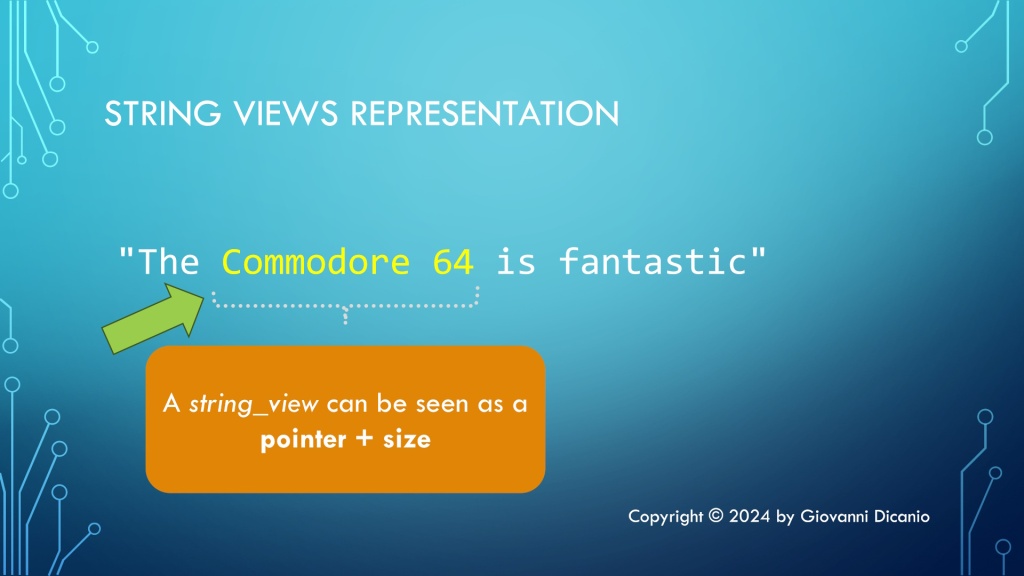
On the other hand, invoking std::wstring_view::data() does not guarantee that the returned pointer points to a null-terminated string. It may, or may not. But there is no guarantee!
So, since [w]string_views are not guaranteed to be null-terminated, using them with Win32 APIs that expect null-terminated strings is totally wrong and a source of nasty bugs.
So, if your target are Win32 API calls that expect null-terminated C-style strings, just keep passing good old std::wstring by const&.
Bonus Reading: The Case of string_view and the Magic String
P.S. Invoking data() vs. c_str() – To make things clearer (and more bug-resistant), when you need a null-terminated C-style string pointer as input parameter, it’s better to invoke the c_str() method on [w]string (instead of the data() method), as there is no corresponding c_str() method available with [w]string_view.
In this way, if someone wants to “modernize” the existing C++ code and tries to change the input string parameter from [w]string const& to [w]string_view, they get a compiler error when the c_str() method is invoked in the modified code (as there is no c_str() method available for string views). It’s much better to get a compile-time error than a subtle run-time bug!
On the other hand, the data() method is available for both strings and string views, but its guarantees about null-termination are different for strings vs. string views.
So, invoking the string’s c_str() method (instead of the data() method) is what I suggest when passing STL strings to Win32 API calls that expect C-style null-terminated string pointers as input (read-only) parameters. I consider this a best practice.
(Of course, if the C-interface API function needs to write to the provided string buffer, the data() method must be invoked, as it’s overloaded for both the const and non-const cases.)





![C4834 warning message emitted by VC++ 2019 in its default C++14 mode, when the return value of a [[nodiscard]] function is discarded.](https://giodicanio.com/wp-content/uploads/2024/01/cpp_vs2019_default_cpp14_nodiscard_warning.png?w=974)
 Giovanni Dicanio's Blog