Suppose that you have some data stored in a std::vector, and you need to pass it to a function that takes a pointer to the beginning of the data, and in addition the data size or element count.
Something like this:
// Input data to process
std::vector<int> myData = { 11, 22, 33 };

//
// Do some processing on the above data
//
DoSomething(
    ??? ,         // beginning of data
    myData.size() // element count
);
You may think of using the address-of operator (&) to get a pointer to the beginning of the data, like this:
// Note: *** Wrong code ***
DoSomething(&myData, myData.size());
But the above code is wrong. In fact, if you use the address-of operator (&) with a std::vector instance, you get the address of the “control block” of std::vector, that is the block that contains the three pointers first, last, end, according to the model discussed in a previous blog post:
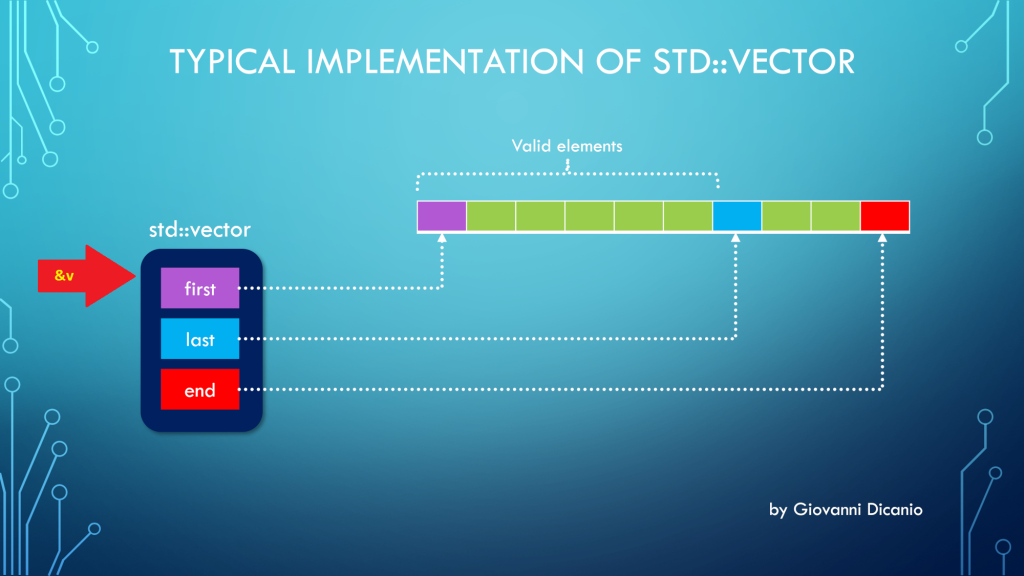
Luckily, if you try the above code, it will fail to compile, with a compiler error message like this one produced by the Visual C++ compiler in VS 2019:
Error C2664: 'void DoSomething(const int *,size_t)':
cannot convert argument 1
from 'std::vector<int,std::allocator<int>> *' to 'const int *'
Types pointed to are unrelated; conversion requires reinterpret_cast, C-style cast or function-style cast
What you really want here is the address of the vector’s elements stored in contiguous memory locations, and pointed to by the vector’s control block.
To get that address, you can invoke the address-of operator on the first element of the vector (which is the element at index 0): &v[0].
// This code works
DoSomething(&myData[0], myData.size());
As an alternative, you can invoke the std::vector::data method:
DoSomething(myData.data(), myData.size());
Now, there’s a note I’d like to point out for the case of empty vectors:
According to the documentation on CppReference:
If size() is 0, data() may or may not return a null pointer.
CppReference.com
I would have preferred a well-defined behavior such that, when size is 0 (i.e. the vector is empty), data() must return a null pointer (nullptr). This is the good behavior that is implemented in the C++ Standard Library that comes with VS 2019. I believe the C++ Standard should be fixed to adhere to this intelligent behavior.
 Giovanni Dicanio's Blog